Monday, 18 May 2026
Lee Cronin’s The Mummy (2026, dir. Lee Cronin)
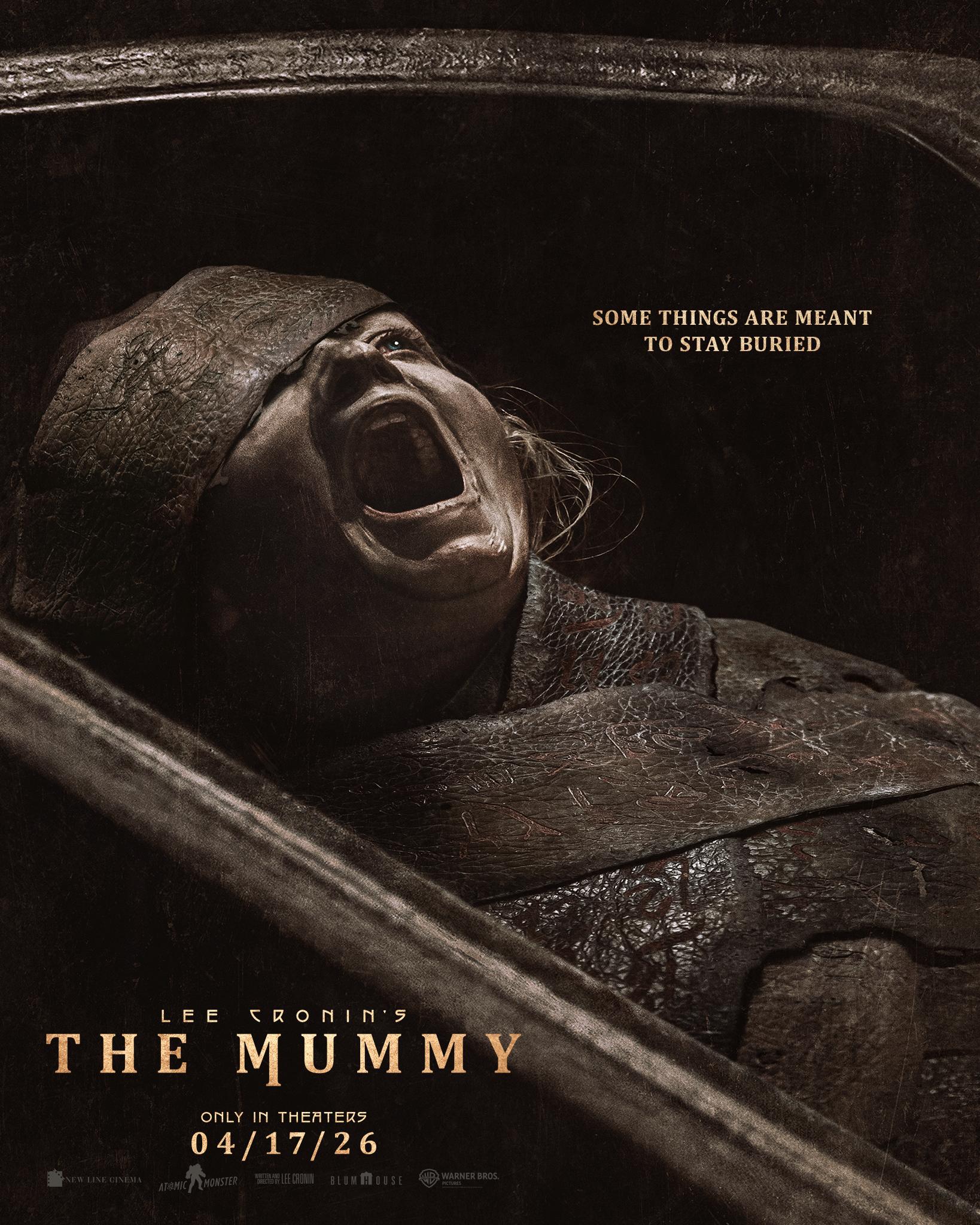
I have seen the trailers for this movie, suffice to say, quite a lot. For the first, like, four times, I was with somebody different and literally every single time, they revealed they thought the title of the movie was the phrase, What Happened to Katie? After all, it is (in my humble opinion) a catchier title than Lee Cronin’s The Mummy, which boasts a naming convention I’ve never specifically liked and demands a very particular reading of the film. But after watching the movie, I want to posit that in fact What Happened to Katie? is a more apt name for the film as it speaks to its central perspective.
This movie is shocking in just how sprawling it is. I can’t think of another horror movie I’ve seen that structures its story in this way. It begins with three consecutive exposition scenes: the lore of the magic, its guardian known as the Magician (Hayat Kamille), and her family; the main family as they lose their daughter/sister Katie (Emily Mitchell) and the brief investigation shortly after; and the main family years later as they learn Katie (Natalie Grace) has been found. And only then do we get into the actual meat of the movie, which also has a ton of storylines going on.
Essentially, Katie returns home and she’s definitely dead. Father Jack (Charlie Cannon) and mother Larissa (Laia Costa) have struggled with Katie’s disappearance and disagree over how to deal with her new idiosyncrasies. The rest of the family is comprised of Katie’s brother Seb (Shylo Molina), her younger sister Maudie (Billie Roy), and her grandmother Carmen (Verónica Falcón). They also deal with the same stuff as the parents, but more off-screen. There’s also the detective Dalia Zaki (May Calamawy) who is investigating what may have happened to Katie during those years she was buried in a sarcophagus, which is separate from father Jack’s investigation with an archaeologist from the local college.
It balances these almost procedural investigations (that, to be clear, reveal next to nothing to the audience that is not also discussed in other scenes) with horror elements. I’d characterize them as sort of action-horror as they’re very much like running around and wrestling this girl’s dead body to stillness, but there’s also a large focus on the decay of her body and bugs. Although I will say that I’m very easily icked out by bugs yet this didn’t really phase me. The corpse stuff was kind of cool, as it tied into these recurring motifs of language, codes, and magic words. This is also the sort of horror movie where it’s all about lore and rules, and in this case they’re so rigidly defined that you can figure out exactly what will happen in every scene based on that.
You may notice that when I’m describing the horror, it’s happening to Katie’s body, not really to her. Similarly, the investigations seem baseless—they’re motivated almost more by curiosity than anything that would do anything to help Katie. This comes to a head in the climax, where we take a huge break from the action of Katie trying to kill and/or control the whole family (and succeeding) so that her parents can watch the video of her being ritualistically tortured and killed roughly a decade prior. And this moment brings the movie into perspective, including the conclusion with father Jack’s gesture to resolve his guilt and the final sequence of revenge against the Magician.
This movie—which as far as I can tell, only nods to The Mummy franchise in the partial setting of Egypt and misplaced retro tech—is not really about Katie, or even her family really. It is about finding out what happened to her and how that affects her parents. While I don’t by any means think this is a bad or uninteresting or not meaningful perspective to explore, it is strange to me how it happens at the expense of Katie, and to a lesser extent the rest of her family. Perhaps it’s just that those initial moments showing the family’s dysfunction don’t hit and feel unexplored and not weighty, but their actual relationship never feels legitimate. The tagline of this movie is “Some things are meant to stay buried,” and aside from being a writing genre-appropriate use of humor, it just continuously emphasizes this point that the horror is what happened to her. And it’s horrifying not to Katie who experienced it and continues to experience it, but to her parents.
I don’t think this movie exists in a vacuum, and I surely think the “failed patriarch” storyline ending in his self-sacrifice and movie-sanctioned revenge on this Magician have more than a little to do with the end product of Katie’s non-character. I find it an interesting topic of conversation and look into a cultural idea that’s usually a little more unpacked or subtle than this, but those reasons are not the crux of my lack of recommendation. It’s just pretty boring.
Sunday, 10 May 2026
Hokum (2026, dir. Damian McCarthy)
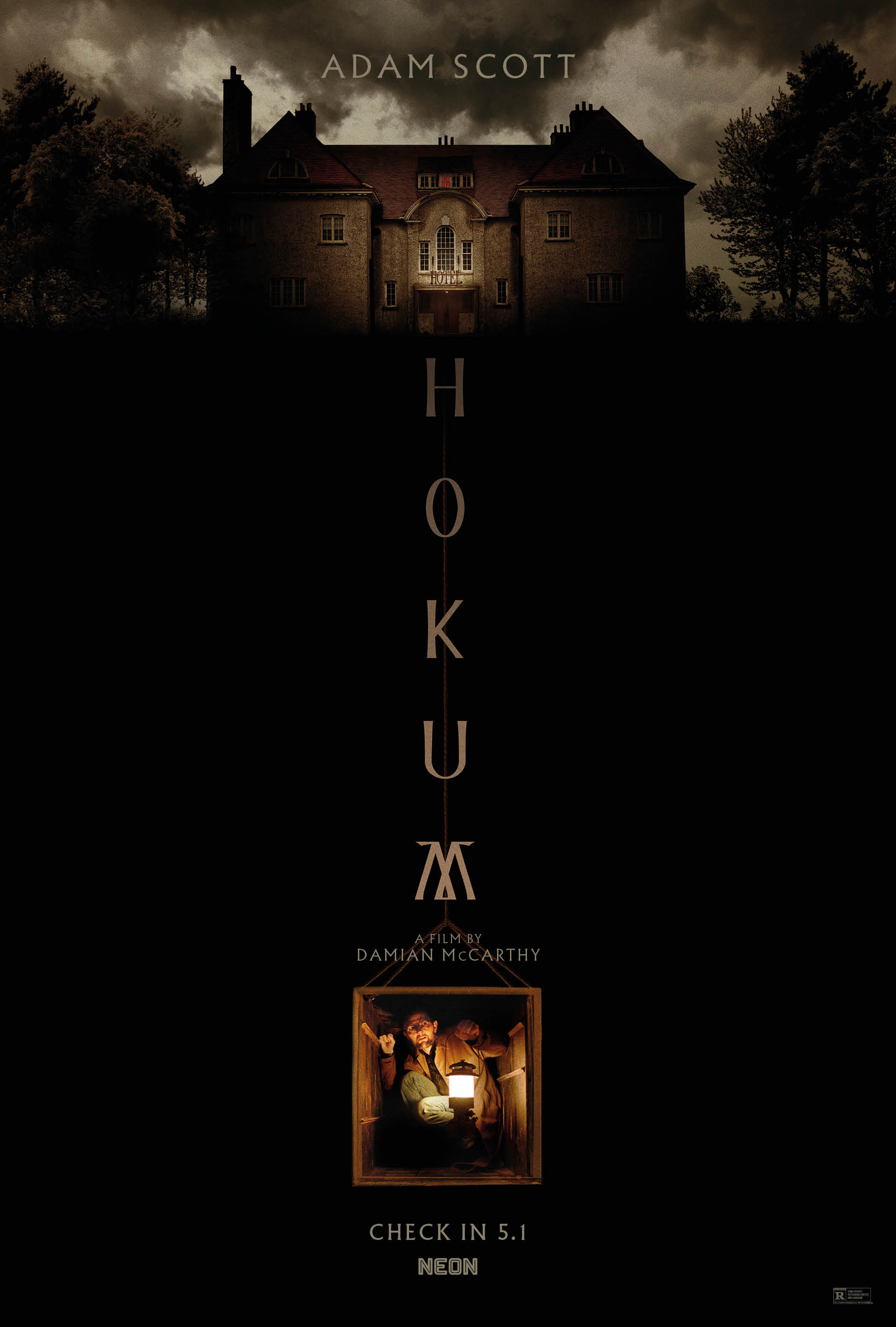
Hokum is a 2026 hotel horror film; in it, author Ohm Bauman (Adam Scott) journeys to a hotel in the Irish countryside to spread his parents’ ashes. After two members of staff save his life following a suicide attempt, Ohm heads back to the hotel to find one of those staff members, Fiona (Florence Ordesh), has mysteriously disappeared. Pairing up with a man living nearby in the forest, Jerry (David Wilmot), Ohm plans to search for her in the hotel’s forbidden honeymoon suite, only to find supernatural and human horrors waiting for him inside.
The hotel horror of this is couched in a frame of Ohm’s novel; while I certainly thought the novel sounded interesting, it felt strangely distinct from the ambience cultivated outside these scenes. It’s a great example of a very classic haunting but brings in interesting lore and really, really well-timed and well-used jumpscares. But again it tries something a little too mundane to be truly experimental, but that doesn’t fully work with the rest of the ambience. Ohm has this arc dealing with the grief over something he did a long time ago, and it manifests in the visual of a children’s show mascot resembling a rabbit. Because the rest of the movie works so well, this aspect feels surprisingly disjointed.
More than disjointed, though, it’s distracting. As I mentioned, the mascot looks like a rabbit—but so does the actually stunning creature design of hotel staff member Fiona’s corpse. She dies on Halloween and is thus left in her costume, which makes for a beautiful and tragic recurring visual. But then there’s a totally different guy dressed up and looking like a rabbit on the television and it makes the movie feel confused and weirdly redundant. He’s actually a donkey from what I understand, but I only see it after being told that… So maybe that speaks to designs that are a bit too similar, even if they are solid otherwise.
I don’t mean to harp on the negatives—this movie was ambient, enjoyable, and truly creepy. I had a really fun time watching it and was truly grateful for the underage drinking that distracted me from the creepiest parts. I mean, one of the main horror elements is a witch and I’m a known witch hater and I liked her role in the haunting a lot. I’m really excited to see McCarthy’s other work and I totally see why people speak so highly of him. But I do have mixed feelings about those more ambitious storytelling moments; I respect the ambition and the attempt, but sometimes simplicity really works. And in McCarthy’s case, it seems like it would really work.
Saturday, 9 May 2026
Clockwatchers (1997, dir. Jill Sprecher)
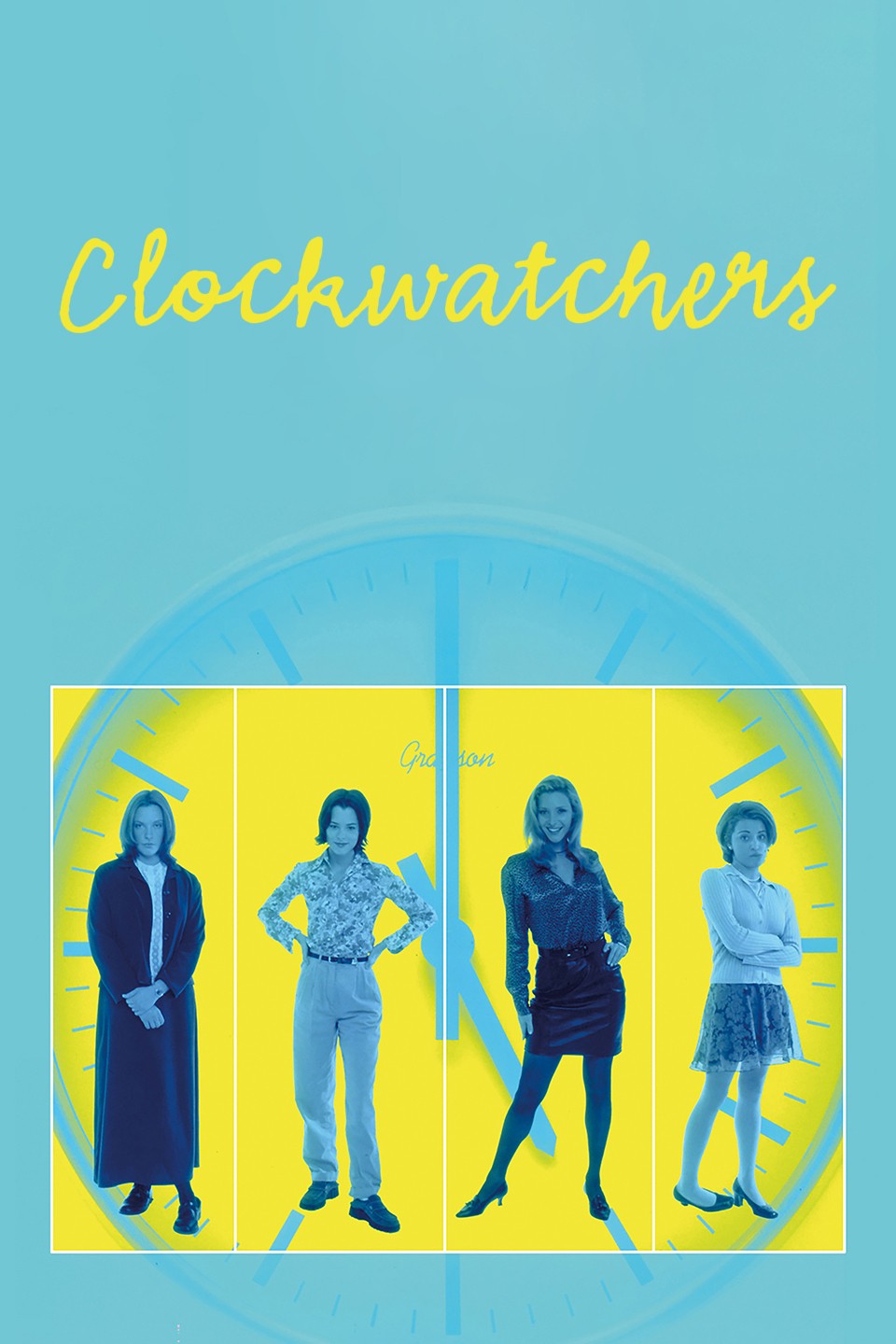
I just have to say: this is one of my favorite films I’ve seen so far this year. My friend who I immediately suggested it to said it best and whom, in lieu of a photo, I will summarize now: four stars on Letterboxd, but a heart. Something about the minute and a half of the trailer I watched made me think these women were going to, like, fight a supernatural office demon with the power of ennui and I will just spoil right now that that does not happen.
To everyone’s immense surprise, this movie is actually about four temps (Toni Collette, Parker Posey, Lisa Kudrow, and Alanna Ubach) in an office building whose presence there is suddenly threatened by a new permanent employee (Helen Fitzgerald) and items around the office suspiciously disappearing. It is the story of the rise and fall of their friendship almost entirely occurring in their shared office space and their commutes home. This movie is a heartfelt look at both tumultuous friendships between women and the disillusionment of transient employees in an office setting. And it’s so indie, oh my god.
First of all, I have to compliment the performances. This movie is a true dramedy in tone, but definitely shows off chops I have not yet been able to see from these actresses. It’s very interesting because the characters all have these foundations of “types” that are immediately made questionable by their depth and specifically their masks, and further broken down as narrator Iris’ (Toni Collette) view of them is broken down. Movies about complicated women are sort of catnip for me, but the way this movie deals with both their personal motivations and fears, their public and platonic personas, and their dynamics with the rest of the group, felt so resonant and meaningful without ever veering into the profound or sentimental.
The film’s climax—and specifically the vast majority of characters’ lack of emotionality—was particularly interesting. It very much eschews the character arc for realism in a way that felt true to the feeling and world that the film built up. It aligns with the place the these characters’ friendship has gotten, and perhaps always was, and speaks to the relevance of the setting that this is how the characters are feeling at this point. The use of Iris as narrator works nicely throughout the film, but it culminates perfectly at the end as we so frustratingly don’t break from it.
I would also be remiss to ignore the set and costume design of this film. The blending of color, print, and silhouette in these women’s wardrobes with the geometric rigidity of the office around them was so fun to look at. And it would be untrue to act like Margaret’s (Parker Posey) wardrobe in particular has not been such an inspiration to me since watching this. But also her performance in general has not left my mind in (now) weeks.
Friday, 8 May 2026
You, Me & Tuscany (2026, dir. Kat Coiro)
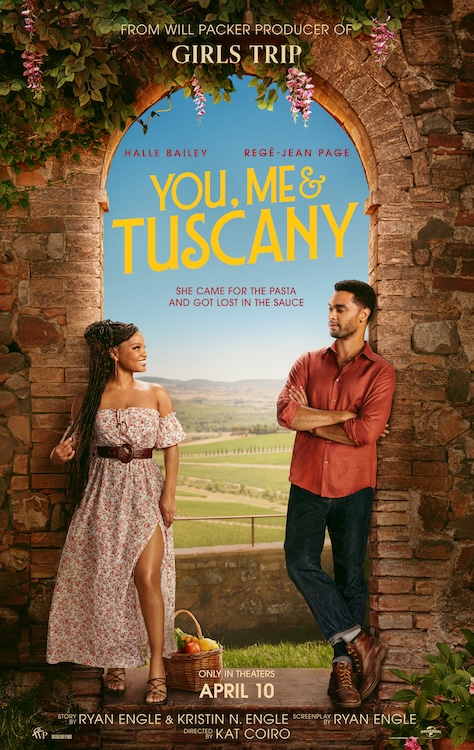
It took me a ridiculously long time to see this movie compared to how excited I was for it—and like twice that to actually write about it, alas! I went in very much expecting a fun romcom, but I overestimated the theater of it all. Director Kat Coiro’s work has always been just in the periphery of my attention; I feel a very similar way about stars Halle Bailey, Regé-Jean Page, and Marco Calvani. And finally I see them come together in this film.
You, Me, & Tuscany is a 2026 romantic comedy that follows near-chef Anna (Halle Bailey) who, while house sitting, pretends to live the lives of her clients. Through a series of circumstances, she journeys to a friend/stranger’s Italian villa and allows his estranged family to believe they are engaged. Of course, she ends up falling for this friend/stranger’s attractive and tragic-backstoried cousin Michael (Regé-Jean Page), but not without also developing a connection to the cousins’ welcoming family, something she has lacked since her mother died.
In this surprisingly (I never check movie ratings) chaste film, I found myself growing obsessed with the visual cleanness of it. There’s this element of polished performance to it; I hesitate to call it uncanny, since that is surely not the feeling it evokes. It’s like walking into a staged room in a house for sale; there is the picture, perhaps literal, of life in these bones, of admirable architecture, but it’s unblemished, uncluttered. It’s a criticism much modern cinema gets, but I think it’s particularly apparent here. This film has two very attractive leads it is so avoidant to allow to appear messy or human. The lead is nearly homeless after a poorly planned trip to Italy and yet her clothes are never rumpled; a family spends a whole work day in a highly trafficked kitchen yet nary a spot of grease or sweat is anywhere to be found.
We see the polish of the film perhaps most obviously in the Tuscan cuisine that makes up a not-insignificant portion of the film’s attention. Anna is trained as a chef, it’s her connection to her now deceased mother, it’s her true passion and her connection to this family that will come to be her own. And while Tuscany is admittedly known for its simplicity in its food, it actually borders on ridiculous just how accessible these recipes are. I don’t begrudge the film this aspect; indeed accessible was the vibe I got most of all, more than underresearched and underexplored (though those are not unfair descriptions, in all honesty). Even the shots of food and eating feel short and lackluster, when not avoided completely. Sure, it looks nice, but it didn’t even make me hungry. The idea of a foody romance has this immense potential for decadence and eroticism that the film seems entirely uninterested in. I’d wager this has a little something to do with the rating, but it seemed hands-off for even a PG-13. You’d think it would lean in the other direction, then: that food is like home and family. But again, that falls flat as this movie has no distinction to it—nothing to, excuse me for this, sink your teeth into.
Coming out of the theater, I was surprised at how much I felt I’d just half-watched a summertime Hallmark movie while people, like, play in a pool and barbeque just outside. There’s a remarkable completion to the shots in this film. Each shot felt clean, unmoored from the shot immediately preceding it, no matter how intense or emotional, a series of bubbles trapped in time, never to touch one another. Quite unlike the fly that lands on Michael’s uncle’s eye. But I digress. Despite the Hallmark feel of the cinematography and editing, the screenplay felt so true to a romance novel. There was this written feel to the dialogue, usually reserved for cute banter but here spreading to all conversations. It mimicked the editing in this way: distant and rehearsed, often lacking anything below the surface. This is, I say as someone who watches my fair share of movies with these qualities, certainly a fine thing to watch; it is just surprising to see with such a massive budget and a full theatrical release in contrast to the type of films I’m comparing that to (although very clearly attributable to the leads’ star power).
It’s a bit late to say this now, but I would not go see this in cinemas as that is not the viewing environment the movie demands. I would, however, write a lengthy review likening it to a theatrical metaphor (compliment; I love theater and theatrical metaphors), or maybe put it on during a sleepover—so long as wine was present. And a piece of toast.
Wednesday, 22 April 2026
The Bling Ring (2013, dir. Sofia Coppola)
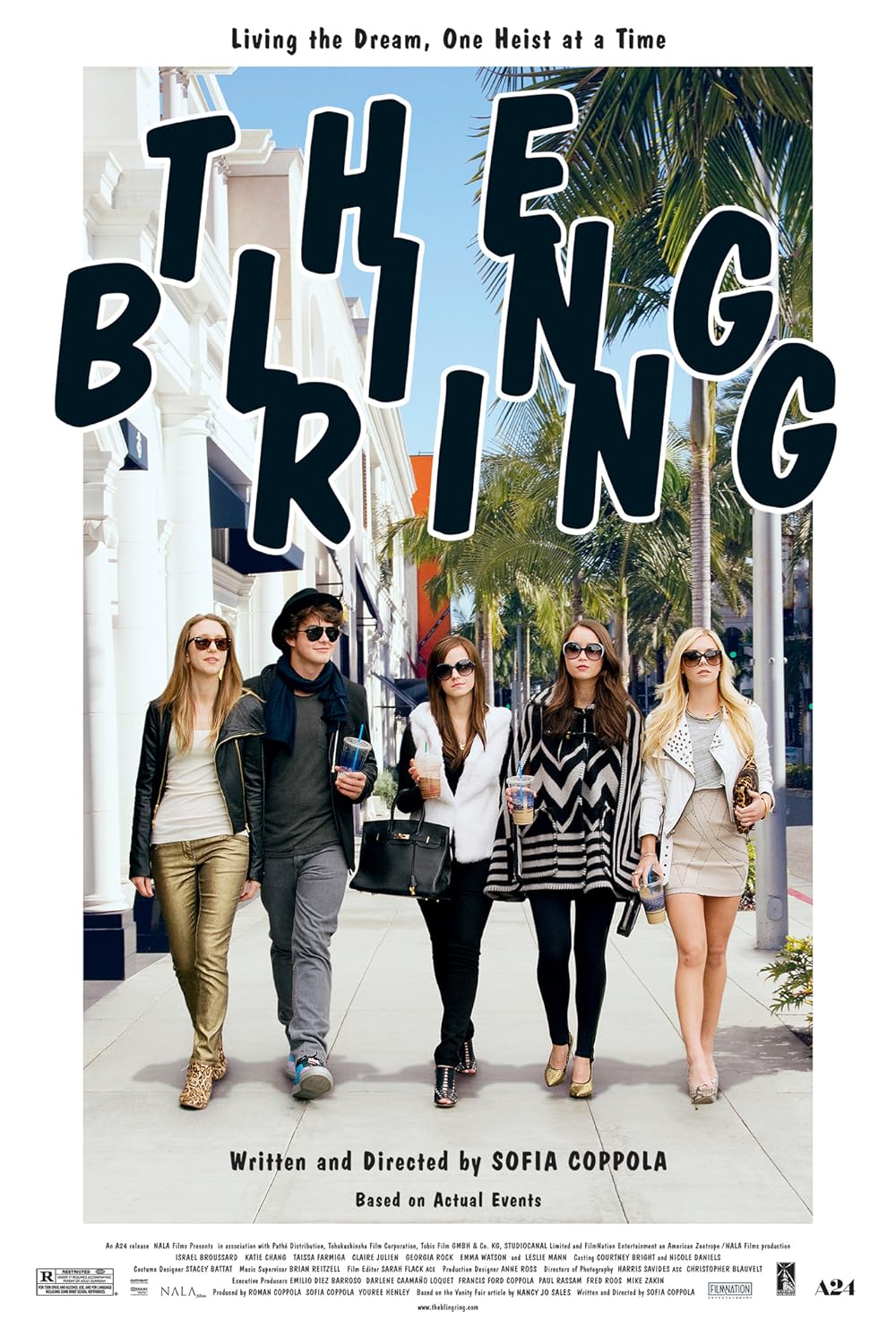
Sofia Coppola’s The Bling Ring is a crime film based on the true story of a group of Valley teenagers who broke into celebrity homes and stole cash and property. I was totally turned around by the end of this movie as I became more accustomed to its stylistic choices and ultimately appreciated them.
The reason this stylistic element stood out to eventually positive reception on my end was its ability to precisely depict the exact environment of its characters—an affluent suburban background. The effect was created by pinpoint sets with characteristic echoey sound and a true eyesore fashion lineup. The bedrooms in particular felt slightly sparse, but overall lived-in. I was obsessed with the kitchens, though, which felt catalog-plucked for their horrendous taste. Budget and star power aside, much of the audio-visual experience of this film was surprisingly nostalgic for me as it reminded me of making home movies with friends in middle school (in the best, most complimentary way).
In contrast to the realism of the production design was the stiff dialogue. It was comedic but also engrossing, earning an equal amount of laughs and eyerolls. The dialogue style definitely contributed to the effect overall—insubstantial and imprecise, yet so, so idiosyncratic. Emma Watson’s California-accent delivery was my favorite, and the uncanny of the put-on accent emphasized the more performative qualities of her character.
That said, I was annoyed with the migrating focus. We begin and end with Watson’s character, but shift to others in the middle as we learn how this habit came to be. It serves to make the cast more ensemble and provide context to their actions, but it simply felt a bit uneven to me. This is definitely a stranger watch, but a fun sleepover flick for sure.
Monday, 20 April 2026
My Sister’s Keeper (2009, dir. Nick Cassavetes)
There’s this phenomenon in the shifting of internet things to be so largely reliant on short-form video in which clips of movies and television shows are posted in one-ish minute increments focusing on the engaging drama of a scene or work of art. If you’re lucky (or unlucky, perhaps), it’ll be more than just this out-of-context moment posted and will in fact be the entire show or movie posted in order. There’s a really specific vibe of all of the things selected to be posted like this. A good example is the show Young Sheldon, which in my experience most often has any and every scene with the titular young Sheldon in them, edited out. It becomes this slightly soapy, dramatic study of a family that, as far as I understand it, does not accurately reflect the tone of the show.
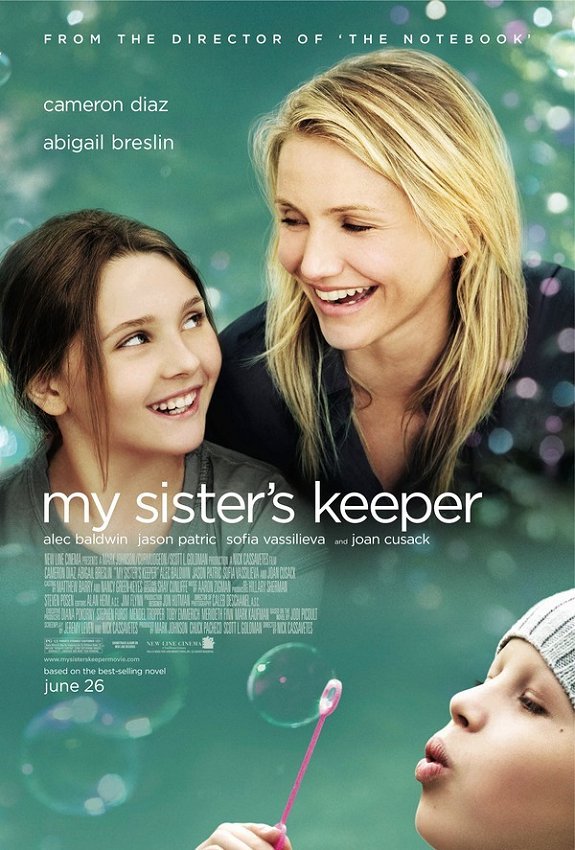
2009’s melodrama My Sister’s Keeper is the frequent subject of these posts, and not without good reason. Its melodramatic tone and captivating premise draw the hobbyist scroller’s attention; its format largely centered around a series of vignettes really lends itself to short-form video. In these bite-sized increments, the movie and its premise (based on a novel by Jody Picoult based on the real-life story of Marissa and Anissa Ayala) are certainly worthy of attention. However, the actual movie does not live up to the concept it promises.
The film promises first a story of the young Anna Fitzgerald (Abigail Breslin), a child conceived to be a donor for her sister Kate (Sofia Vassilieva), who suffers from promyelocytic leukemia. The two are surrounded by their loving family, comprised of mother Sara (Cameron Diaz), father Brian (Jason Patric), older brother Jesse (Evan Ellingson), and aunt Kelly (Heather Wahlquist). After Kate goes into kidney failure, Anna reaches out to an attorney (Alec Baldwin) to represent her in suing her parents for medical emancipation. Most of the movie deals with various perspectives on the whole situation, focusing attention on Kate’s first love and experience and Anna’s case under Judge Joan De Salvo (Joan Cusack).
As mentioned, the movie takes on this vignette format, moving through time and perspectives reflected in voice over narration that’s soon abandoned and never necessary. It is a strange format and not one I think adds much to the movie. It makes it feel aimless and meandering—a fine choice in description, but disjointed against an opening and closing related to a court case. That court case never quite has the presence its introduction demands, the movie focusing instead on the melodrama.
I don’t want to imply that the movie has no interest in its premise—rather, the focus on the melodrama is the answer to the question Anna sets up. I am perhaps putting too fine a point on it, but I’m just not a fan of melodramas. Like in many, you get really strong performances but they speak to a whole I find myself bored by, keen to poke holes in. I think negatively of the thesis and feel worse about the execution. They feel, as the genre demands, full of flat characters and overly moralistic themes. A movie like this, which proposes or implies a complex story about bodily autonomy, duty to others, and care for one’s loved ones, instead becomes an attempt to elicit tears and sentimentality. I struggle to even give it the goodwill of catharsis due to how poorly and/or generically it handles much of its conflict.
Sunday, 19 April 2026
Something Very Bad Is Going to Happen (2026, created by Haley Z. Boston)
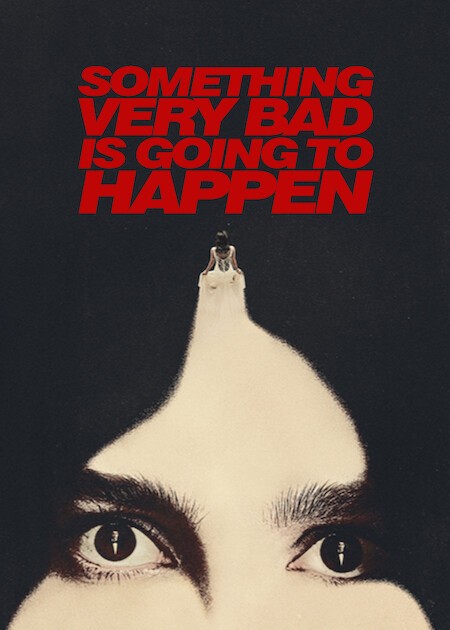
In what is turning out to be a year of sentence-long titles, Something Very Bad Is Going to Happen is a horror limited series that follows Rachel (Camila Morrone) as she visits her fiance Nicky’s (Adam DiMarco) family cabin for their wedding. What she finds when she arrives is a family full of characters and a hereditary curse on her wedding. The tragic thing about limited series is that I am in constant want of one, yet they are over in like a weekend. This is one of those cases, where I’m left wanting more by the end, even while I’m satisfied with the story—I’d say that’s a good sign.
The show opens with my favorite episode. Soon-to-be-married Rachel and Nicky are making the drive to the picturesque, rural area of Nicky’s family cabin—an area with a deceptively sweet yet tragic past. It’s a road trip out of I’m Thinking of Ending Things, full of uncanny yet weighty encounters. Time and crime seem to be folding in on themselves, repeating some patterns and leaving others to be breadcrumbed throughout the rest of the show to various levels of ability. It’s truly a remarkably strong start. Morrone and Rachel brings a very realistic feeling of anxiety to the horror, although whether she is the only person reacting sanely or creating this terrifying ambience in her head, is unclear.
At the end of this episode and the start of the next, Rachel finds herself receiving warnings about her marriage to Nicky and a strangely resistant family to welcome her. There are the standoffish Jules (Jeff Wilbusch) and Nell (Karla Crome), the glamorous and controlling Portia (Gus Birney), and the secretive yet most level-headed parents Victoria (Jennifer Jason Leigh) and Boris (Ted Levine). This is where Rachel’s anxiety really makes the horror stand out—in the awkward and surprisingly scary mundane interactions. This moment also explores some of the lore of the wood around the cabin and Nicky’s brother Jules’ trauma around it. Though that briefly pales in comparison to the dysfunctional family drama that characterizes the next episode.
As the show goes on, mysteries are revealed—namely introducing the curse on Rachel’s family. The middle of the show is discomforting and freaky. It’s not as check-behind-your-back scary as the first episode, but it is enrapturing. Then comes a major shift in the middle of the sixth episode to a suddenly campy “final act”. It is a very surprising turn, though fortunately one I liked as all three types of horror that the show covers are very much my style. The final episode drags a touch, and we see a truly baffling set of reactions to the frightening mysteries still left open. The climax of that episode is particularly hard to follow as the rules we’ve established, while consistent, are just weirdly applied. And ultimately, it fails to wrap up some of the threads it established in the first and early episodes.
But with that said, the ending, in all its confusion, is ambitious and meaningful. It’s attempting to do a lot and I found that I was delighted with its earnestness. I got the gist of what it was going for, the feeling that the emphasis on aesthetics didn’t fully realize, and that made me ultimately really happy with this show, despite its flaws.
This show was really what I needed. Horror in television can be challenging, but this show actually used the episodic format really well to keep it scary. Although it was a shock, the shift into camp near the end actually complemented the themes and events in a nice way. It’s made me so curious to check out this crew’s other work and will go in my uncanny road trip horror opening list with ardent favor.
Wednesday, 15 April 2026
The Drama (2026, dir. Kristoffer Borgli)
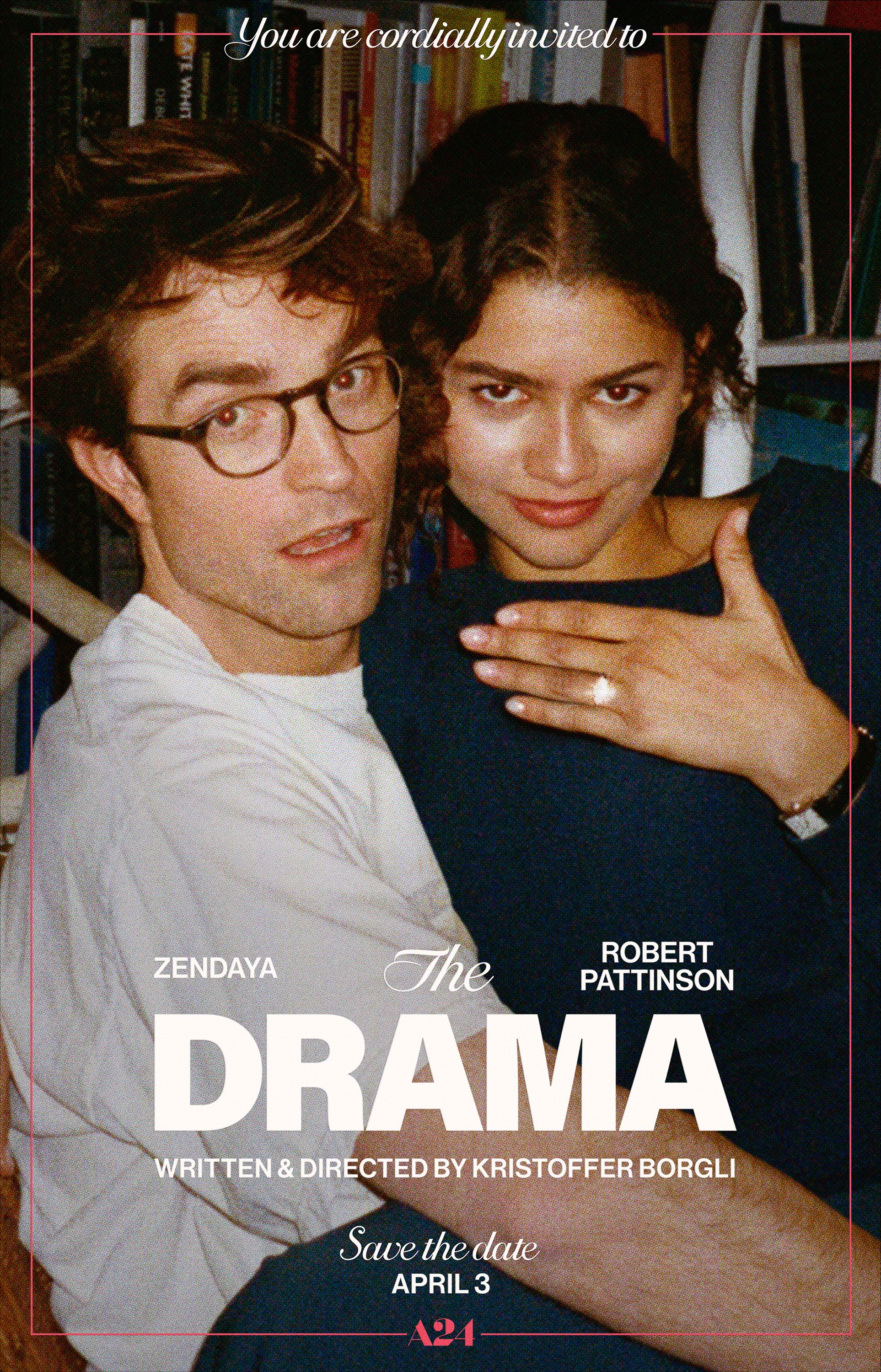
Wow, this movie has been the hot topic the last few weeks due a variety of things, perhaps most prominently the disjunct between its marketing and its content. It elicits a warning to myself I have not and will never follow: to never read comments. The topic of this film and its marketing produces this surprisingly noncommittal moral posturing focused on feelings of discomfort while watching rather than actual analysis. But dare I say: that exact discomfort is pretty unambiguously what the film is going for. I’ll save my thoughts on the marketing for subjecting people in my personal life to, and instead focus on my utter appreciation for this movie. In short, I really enjoyed it. I’ve seen it twice and loved it both times. I can’t recommend it enough.
The Drama, leaning into big spoilers I’m sure many people are already aware of, is a romance movie about a couple, Emma (Zendaya) and Charlie (Robert Pattinson) just a few days away from their wedding. At a dinner with the best man Mike (Mamoudou Athie) and maid of honor Rachel (Alana Haim), the group reveals to each other the worst things they have ever done. In Emma’s case, her secret (that she planned a mass shooting while in high school) is received poorly, and the movie details the fallout, primarily between Charlie and Emma as their wedding approaches.
Subtle the film is not, but not distractingly so. This is a movie about two big ideas: how we treat other people after knowing the worst side of them and American reactions to mass violence. And it treats those ideas with a lot of complexity that I really appreciated.
I’ll start with the first idea: knowing the worst side of someone. This is baked into the main romantic plotline as Charlie reckons with Emma’s confession. The movie blends thoughtful yet minimal character work with the broad idea of Charlie’s perspective. The first time I watched the film, I thought it adhered closely to his point of view, but it felt broader the second time through. He orients the story, including many of the imagined scenes and shots that skillfully blend anxiety, rumination, and (sexual) fantasy. But another watch proved to highlight another layer: conspiratorial glances and reactions we’re not sure if Charlie sees.
We see it further in the careful detail present in the very long confession scene: the threads of conversation, small yet intentional remarks that lead to Emma’s decision beyond her plenty of drinks. It’s a microcosm of the rest of the movie, though particularly concentrated, and I think it’s part of the reason this film has garnered so much attention. I could point out the obvious—the content of the other secrets, in particular maid of honor Rachel’s—but there is such an interesting momentum to this scene, I think only seeing that particular detail is a loss. You see a similar sense of idiosyncratic detail in the three separate instances of one-off run ins with a dance instructor, florist, and DJ. These scenes are all really funny: they got the most consistent laughs in both showings when that was otherwise contentious. But they also serve as a glimpse into full lives outside of the main characters’—and not just that, but they act as moments where people are perhaps not being their most charitable or at their best. It’s a small detail that went a long way in broadening the ideas present in the conflict of Emma’s past.
The second idea, American reactions to mass violence, is considered with three main arguments: the cultural outsider Charlie being the focus of the film, Emma’s identity as a Black woman, and the later inclusion of anxieties over gossip. Charlie’s exterior perspective speaks to how the movie conceptualizes ideas of forgiveness and action. It’s called into question when he asks a coworker her take on the situation, starkly bringing up an idea that has until this point been primarily explored in the visuals and flashbacks: that Emma is a Black woman, and thus not the prototypical figure for contemplating such violence. And finally, in what I’d actually argue is a weaker point of the movie, it reduces this idea that characters are initially taking quite seriously into gossip. As an example of this idea, Rachel, a very important figure in this movie, is affronted and horrified by Emma’s confession, but still performs with some level of decorum at her wedding—however messy she is being (and she is being messy). It works in initial contrast to her earlier reaction, but also complements it.
Aside from the lofty ideas this film presents, it is skilled elsewhere. I was majorly impressed by the casting and performances feeling so perfect and just the right amount of ridiculous to be real. I was fortunate to see it in 35mm, and it is a very gorgeous movie. Although I think my eyes are not quite expert enough to see a real difference. On my initial watch, I found myself struggling to catch up with the rapid-fire editing style, but the second time through I was not bothered at all.
One of the most interesting parts of the movie to me was the audience reception and the differences between the two showings I went to. At the first, on opening day, there had been content leaks but perhaps not yet as mainstream. The audience was engaged and reacting at first but at a certain point (involving a red shirt), the movie lost them almost entirely. In contrast, the second crowd a week later didn’t start laughing until well into the movie as it took a moment to get them on board. This was just a fascinating difference and part of the reason I think the cultural idea of this movie is so intense right now, and also why it works.
Thursday, 9 April 2026
Ready or Not 2: Here I Come (2026, dir. Matt Bettinelli-Olpin & Tyler Gillett)
The first Ready or Not movie is one of my most rewatched movies—it’s fun and witty and tense, tying together action horror with more significant commentary, delivering these iconic visuals steeped in cultural relevance and aesthetic appeal. I love literally everything about it and was so surprised yet excited to see a sequel coming out. For so many years, I’d praised this stand-alone classic, and lamented that the movie leaves little room for a sequel. And how right I was.
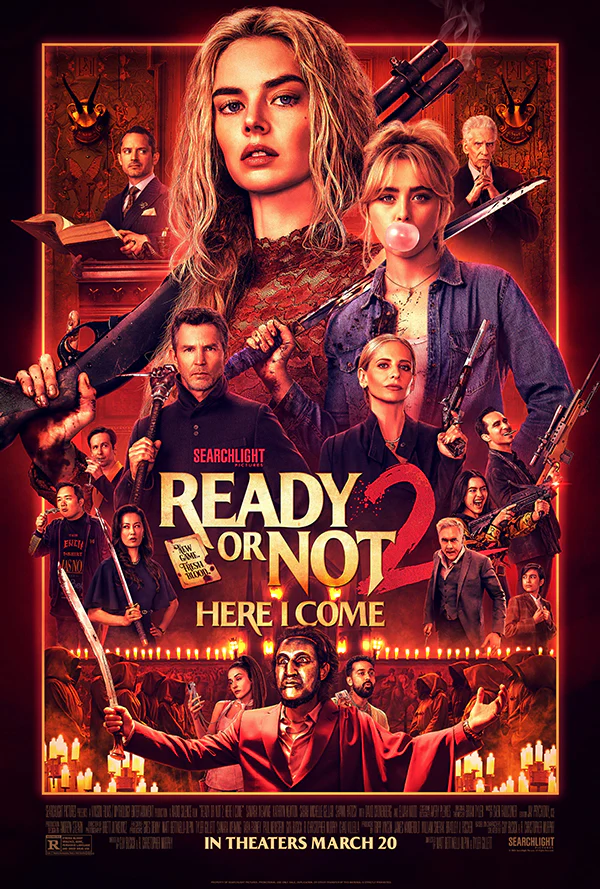
As much as I’m tempted to, I can’t divorce this movie (or its sequel) from the cultural spot it takes up in my mind. Following the late-2010s trend of overtly socially conscious horror, the first film in this series boasts explicit ideas about marriage and class and wealth (some if not all of these tragically difficult to depict with any sort of finesse or novelty), but does so very firmly rooted in the comedy horror space and taking so much of its foundation from the supernatural-slasher subgenre. There’s this iconic visual on many of the posters and the trailer of Samara Weaving in this lacy white wedding dress with an antique shotgun and bandolera and in this gold-tinted lighting and it truly so well captures this film’s vibe… and attempts to capture this film’s vibe as well.
Yes, the iconic bloodied wedding dress returns in 2026’s Ready or Not 2: Here I Come, a choice that symbolizes my plethora of issues with it. What once was a stunning costume choice reflecting a lovely production design choice becomes a sequel’s best effort at continuing a legacy it cannot carry on. That’s the thing about this movie: it is doing nothing new.
Ready or Not 2: Here I Come picks up exactly where the first film left off: Grace MacCaullay (Samara Weaving) on the steps of the burning mansion of her dead (ex?) husband’s family. She’s rushed to the hospital where her estranged sister and emergency contact Faith (Kathryn Newton) visits her. Meanwhile, the collective of families who made deals with the devil for wealth plans to hunt Grace down due to some clauses in their rules. Leading—by the film’s focus and not in so successfully in practicality—the collective are twins Ursula and Titus Danforth (Sarah Michelle Gellar and Shawn Hatosy). Along with five (and quickly four) other families, they chase Grace and her sister across a golf course, mostly, in aims of killing her for their own gain.
Highlighted by an early flashback to the first film, the actual visual style of the sequel is totally different—the yellow tint removed, the costumes vaguely wealthy but mainly nondescript, the setting an eternal blue sky on a bright green golf course (and the occasional casino). But then there are these half-hearted attempts to echo the first film: the antique weaponry, for one. This is one of many efforts to reference that film, remind you every time Kathryn Newton’s katana exchanges hands that this film has character, if only you have the eyes to see it.
Another more egregious instance of this: the introduction of a half-dozen rules to orient the film. I get it, the first movie was about a board game empire and the title refers to the hide-and-seek game’s chant, so the second has to have the same concept. Only the best explanation we get is tradition (speaking in a Doylist sense here; there is an in-universe explanation) and the execution leaves you counting. This film relies on this list of rules to kind of give the action some structure and emulate having character, but instead they guide the narrative with so few teeth that conflicts have little gravity and the ending is underwhelmingly predictable. There are further attempts at other writerly things that amount to very little: lack of specificity in the characters, foils and parallels leaving much to be desired, and a fumbling idea of a thesis. In short, it’s incoherent and generic (though certainly not the most incoherent or generic movie written in part by Guy Busick release this spring).
One of my main points of praise for the first film was the commitment to fleshing out the wealthy characters, though this film makes hardly any effort to do the same. There’s some Busick-typical sibling parallels that don’t hit here at all. The exceptions were Samara Weaving’s charming reprisal of main character Grace and the always lovely Kathryn Newton bringing just an excellent energy amidst all this blandness. There are some stand outs in the cast of the families, like Maia Jae as Grace’s dead husband’s jilted fiancée, but she’s given little time to shine amidst a huge cast. It was entirely too many people we knew little about and the world felt all the emptier for it. This doesn’t even take into account that for so many of these characters, the majority of their scenes were watching the action on a security feed and commentating. Riveting character work that allows.
This movie feels like someone who has only ever watched sort of bland action movies got a summary of Ready or Not, placing nonsensical references to the first film over the just such generic visuals. It’s trying to do way too much at the same time it’s not doing anything at all.