Sunday, 31 May 2026
Is God Is (2026, dir. Aleshea Harris)
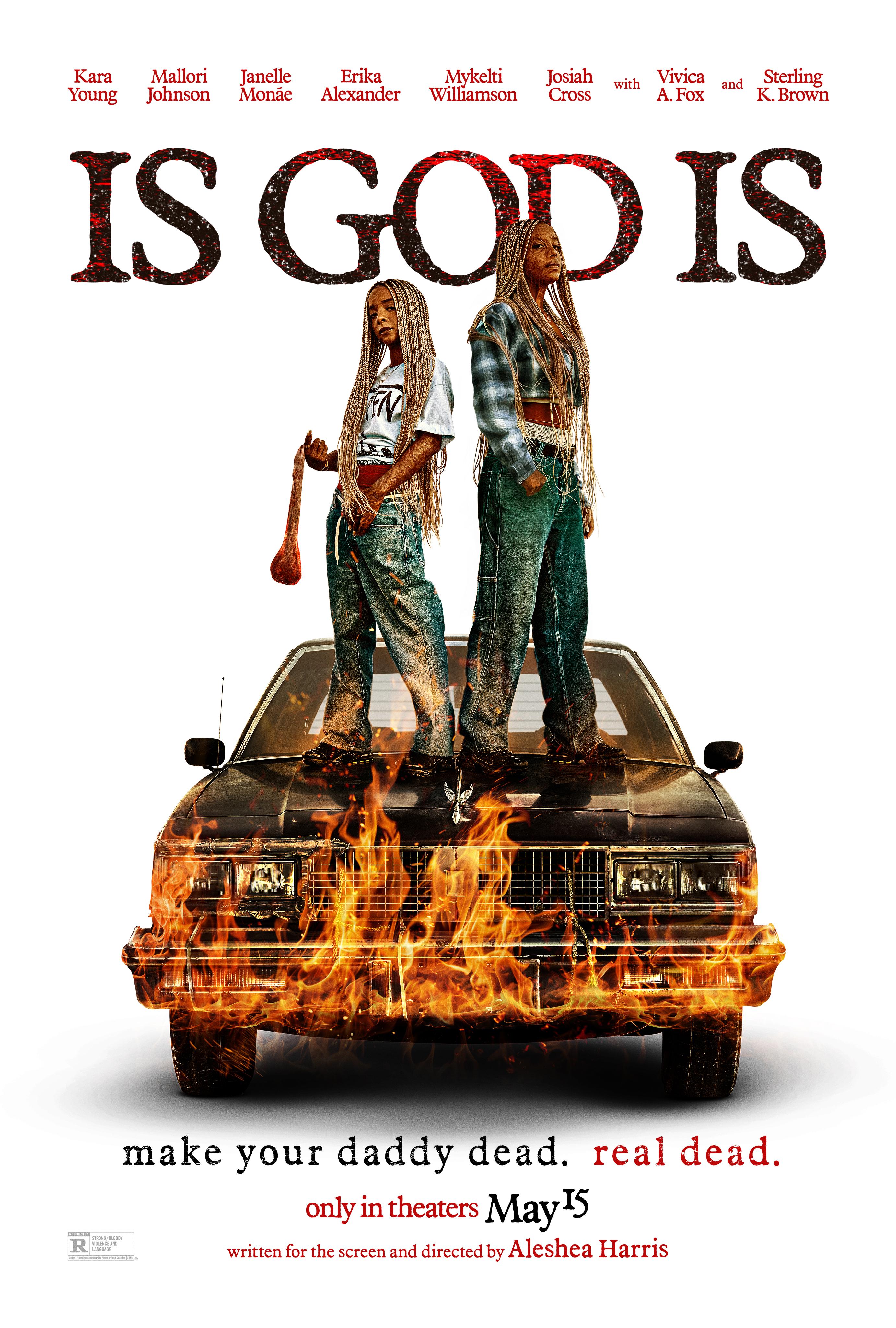
I cannot believe I nearly slept on this movie and it’s totally one of my favorites so far this year. Based on writer-director Aleshea Harris’ play of the same name, Is God Is is a southern gothic thriller about twins Racine (Kara Young) and Anaia (Mallori Johnson) whose estranged mother (Vivica A. Fox) instructs them to kill their father (Sterling K. Brown). It has these incredible performances and stylish visuals that blend the story’s theatrical history with the film medium in a way I found so fun.
Just to start, this movie filled two voids I’ve been seeking to fill for a while: just a good, solid thriller and incredibly immersive ambience. There’s this way the film transitions between locations with, for lack of a better explanation, staged shots of the characters’ outfits, car, and location that seamlessly brings together its theatrical origin with the language of video. To my memory, it’s not something I’ve seen in a movie, but it is a trend in music videos and it developed this film’s tone and these characters in such a cool and memorable way. This is Aleshea Harris’ first feature film and clearly she’s an established and incredibly skilled director and writer, but to so well translate the story into a new medium shows another level of pure talent. Wow! I really do wish I saw this as a play to see how it changes.
Also: the performances are so captivating. I mean, it has a cast of serious note, and despite that, lead Kara Young stole the show for me. Her theatrical background makes itself known here as she shines a light on Racine’s complexity in her electric energy and consistent righteousness. The dynamic between Racine and Anaia was a strong heart for the film, using them as foils in the best way and also bringing in idiosyncratic elements like their wordless secret language.
The film overall balances this complex understanding of its characters and plot with humor and just downright good time. It reinforced why I love the thriller so much as it as it brings out the best parts of film and allows for such creativity in filmmaking. Is God Is is stylish to the core and more meaningful for it, using every element of its medium—performance, visuals, editing, writing—to make it utterly captivating. I’m excited for this one to be released outside of theaters, because I’d love to watch it again.
Wednesday, 27 May 2026
Passenger (2026, dir. André Øvredal)
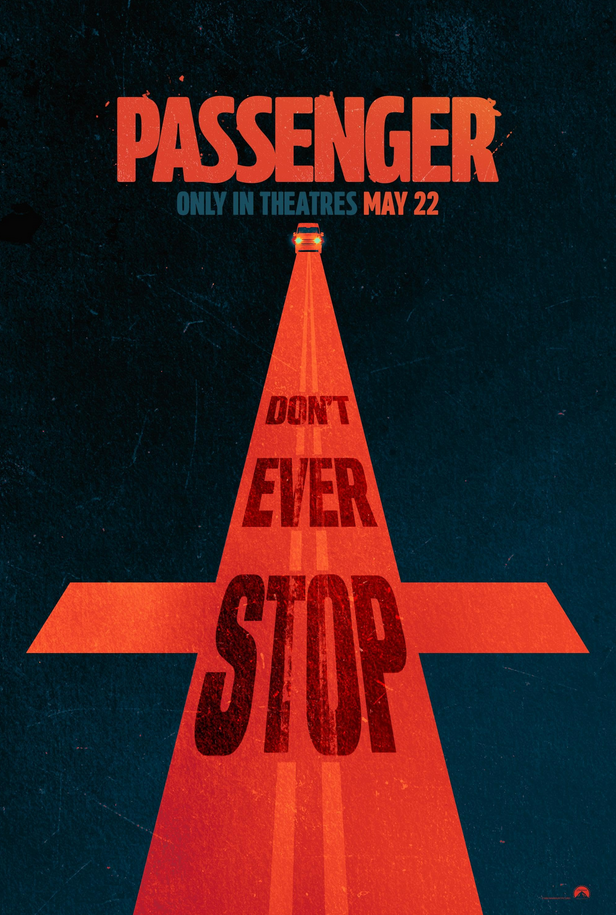
If you have seen any films lately or perhaps ads online, you may have come across a terrifying yet absolutely engaging trailer for this movie. In the trailer, a shortened version of the opening scene, two friends drive down an isolated road at night before being attacked and followed by a mysterious, supernatural figure. It’s honestly some of my favorite marketing I’ve seen this year, scaring me (and the rest of the crowd) in a crowded theater despite knowing about it ahead of time. And I’m sorry to report that it’s basically the only interesting scene in 2026’s Passenger.
Departing from this pre-title card precision and excitement, this movie follows couple Maddie (Lou Llobell) and Tyler (Jacob Scipio) as they depart on their journey of van life, traveling across the continent on the road in a van. This opportunity promises freedom, but it’s not long at all before Maddie grows discontent with their new lifestyle, a feeling she keeps close to her chest. Shortly following Tyler’s proposal, the couple find themselves on an isolated road where a driver who has seemingly just initiated an interaction characterized by road rage (though the audience of course recognizes the car from the earlier introductory scene), winds up in a bad crash. They pull over to help the then-still-alive driver but not before being marked by a demonic entity for deaths of their own.
Right away, you may notice a glaring issue with this movie that, fear not, will be restated several times throughout its runtime just to really drive (ha) the point home that one should under no circumstances stop to help someone in a bad accident lest they run the risk of being targeted by this demon. And it sure is a demon. This all-powerfully telekinetic, aimlessly violent creature who stands in opposition to Saint Christopher and presumably all-good Christian god. Yes, I’m revealing my bias against demonic and religious horror, which is that it only works as horror to a particular demographic and like lowkey reinforces some particular ideas I disagree strongly with. But I think the way such a subgenre of horror interacts with the ideas this movie has about community and isolation, is particularly insidious, even potentially to a religious audience.
Concept aside, we’re dealing with characters who have little substance beyond their plans to get married and twice-stated (back-to-back!) childhoods of varied tumult. They’re going through encounters with this demon (the titular Passenger, for reference) that are initially cleverly-staged jumpscares yet quickly fall into the issue where you see far too much of the creature to be scary anymore, as well as quick and dubious research sessions about “hobo code” after the demon puts a mark on their van. Most obnoxiously, though, is Maddie’s refusal to share with Tyler the extent of the demon’s presence, which stems from the character trait of reservedness she demonstrates but is practically beyond careless given their situation. I will say, it’s been a while since I’ve been so mad at horror movie characters for doing the dumbest possible thing in a situation—clearly I prefer them more analytical.
As the movie picks up, Maddie and Tyler venture to Arizona to find Diana (Melissa Leo), a woman who cryptically warned Maddie about the demon closer to the start of the movie. Upon arriving, the camp she’s in is hostile to the couple, to which Diana chides them for bringing this evil to a camp of “good people.” I did get a bit hung up on that detail, considering the only good things we saw people do were Maddie stopping to help the crashed driver, which they get cursed for, and Diana acquiescing and agreeing to help them, which—spoilers—she immediately gets killed for. The whole movie just feels so ridiculously on the nose with these ideas, which only become more apparent as the movie comes into its climax.
There are a few scenes of Maddie and Tyler fighting this demon (not really literally) as they try to drive to a safehouse, a church of Saint Christopher off any marked roads and maps. Maddie eventually sees a hobo code sign directing them in the right direction—quite a choice to follow considering the demon was the one using the code before, but a detail that doesn’t seem to matter ultimately. They drive until they find a church in the desert (so picturesque, just wait) and go through a few trials to reach it. It ends with a big fire and the couple sitting happily together while emergency services arrive and they can sit happily with their looming future of living in a gated community and terrifying fear of the rest of the world.
Now, there are criticisms of this film pointing out how little it has to say about bigger ideas like the dangers of driving, cultural ideas about freedom, an alternative option of stability and what that implices—the list goes on. But I’d argue that criticism fundamentally misunderstands the fairly reactionary politics of the movie. In this film, there are markers of community between van lifers, such as parties and campfires and friends, but the conflict is isolated to this couple. They battle the demon (again, all-evil and remorselessly violent) together and with no help. This doesn’t come across as empowering or pleading but as horrifyingly lonely. Even their quip at the end, their plans to be part of a gated community, has this sense of isolation amidst conflict, this potentially debilitating fear that, to the uninitiated potentially ironically, is shocking in a horror movie. There’s an argument to be made that these are strangers and have no reason to help, but to that I say misunderstands cinema as a medium, which frequently introduces characters who have massive effects on each other’s lives within a matter of days. There’s a sociability inherent to the genre (of film) that is actively undercut here in service of an isolated worldview. This, despite occurring amidst every sort of social gathering place you can think of—parties, restaurants, camps/neighborhood equivalents, and the climactic church.
Unless you’re looking for an easy A in a film course, I would not recommend this movie. Maybe the trailer, if you’re so tempted, because everything after is dull and full of cliches. But at the same time, it’s missing that road trip horror cliche of characters just chatting on a long stretch of road, a choice that would’ve been helpful in giving the audience really anything to root for about these characters. In all honesty, I should’ve recognized director Øvredal’s name from The Autopsy of Jane Doe, one of the earliest movies I reviewed on here that I very much did not like, for some of the same reasons. I think his genre flicks are just really not for me. Really cool marketing, though.
Tuesday, 26 May 2026
Forbidden Fruits (2026, dir. Meredith Alloway)
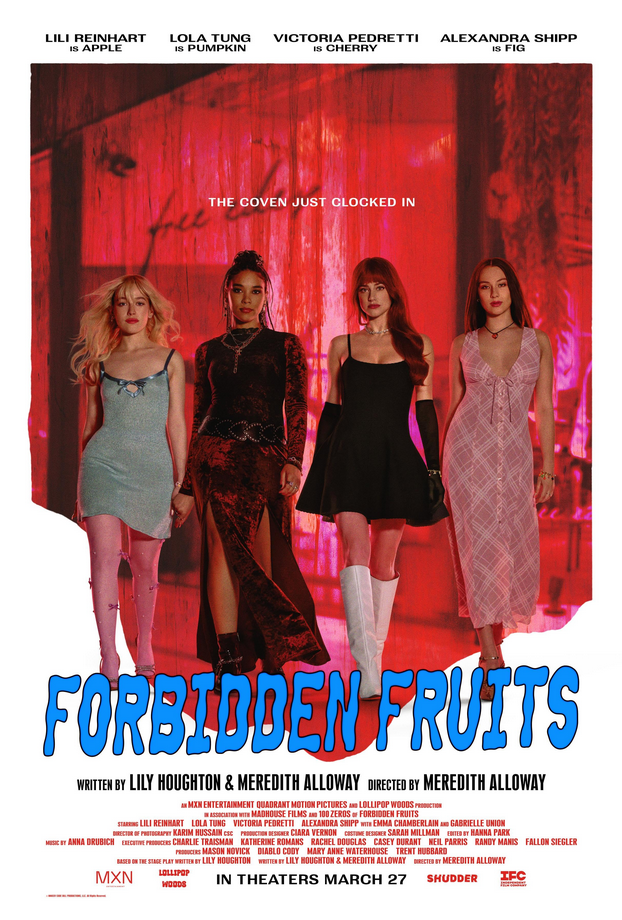
Going into this film, I was both excited and terrified. On the one hand, a candy-colored flick about mall witches full of actors I’m a fan of is certainly appealing. But on the other, there’s this seemingly universal truth about these modern-day maximalist, candy-colored, deliberately camp black comedies drawing on a tradition of movies I totally adore, which is that I often find them cheesy in a way I can’t defend. From trailers alone, this one toed the line but I think ultimately brought it around.
If you’ve heard of Forbidden Fruits, then you’ve probably heard it’s like Mean Girls but witches. This is remarkably accurate, and not just in tone and visuals, but also in structure. In the film, mall employee Pumpkin (Lola Tung) infiltrates the cliquey crew of Free Eden, a coven of close-knit witches (Lili Reinhart, Victoria Pedretti, Alexandra Shipp) with a strict set of rules and a handful of secrets. What follows is basically the plot of Mean Girls with some characters shuffled around and an emphasis on the witchiness of it all, but lowkey. It culminates in an all-out horror confrontation during a tornado.
This movie is fun, first—it’s funny, it’s bright, and it’s just a real joy to watch. There’s a familiar cast of characters, but I still found them charming and occasionally fresh, especially Alexandra Shipp’s Fig and Lili Reinhart’s Apple. The gore-focused climax was definitely a surprise based on the film’s marketing and content, although less so if you’re familiar with the cultural inspirations of the film.
Perhaps predictably, I have something to say about the costumes in this film. I’ll admit I was frightened by the early images I saw of them, but they came together in the movie’s ideas about retail and femininity. The character details definitely informed the costume-y ness of their looks; so often in comparable movies the colorful, maximalist aesthetic often feels at odds with the characters, and ugly to boot. But with this film, I could see how these characters came to dress in these just-off, TikTok-esque, -core fashions. It ended up contributing a lot to the movie’s thoughts about appearance and femininity. The inspirations for the costumes are all over the screen—and just so happen to comprise one of my Letterboxd lists—but they’re doing something fresh with the performance of it.
Basically this is a fun sleepover watch, like your third film of the night after a few people have already wound down. It’s not perfect by any means, but I was pleasantly surprised and enjoyed my time!
Monday, 25 May 2026
Obsession (2025, dir. Curry Barker)
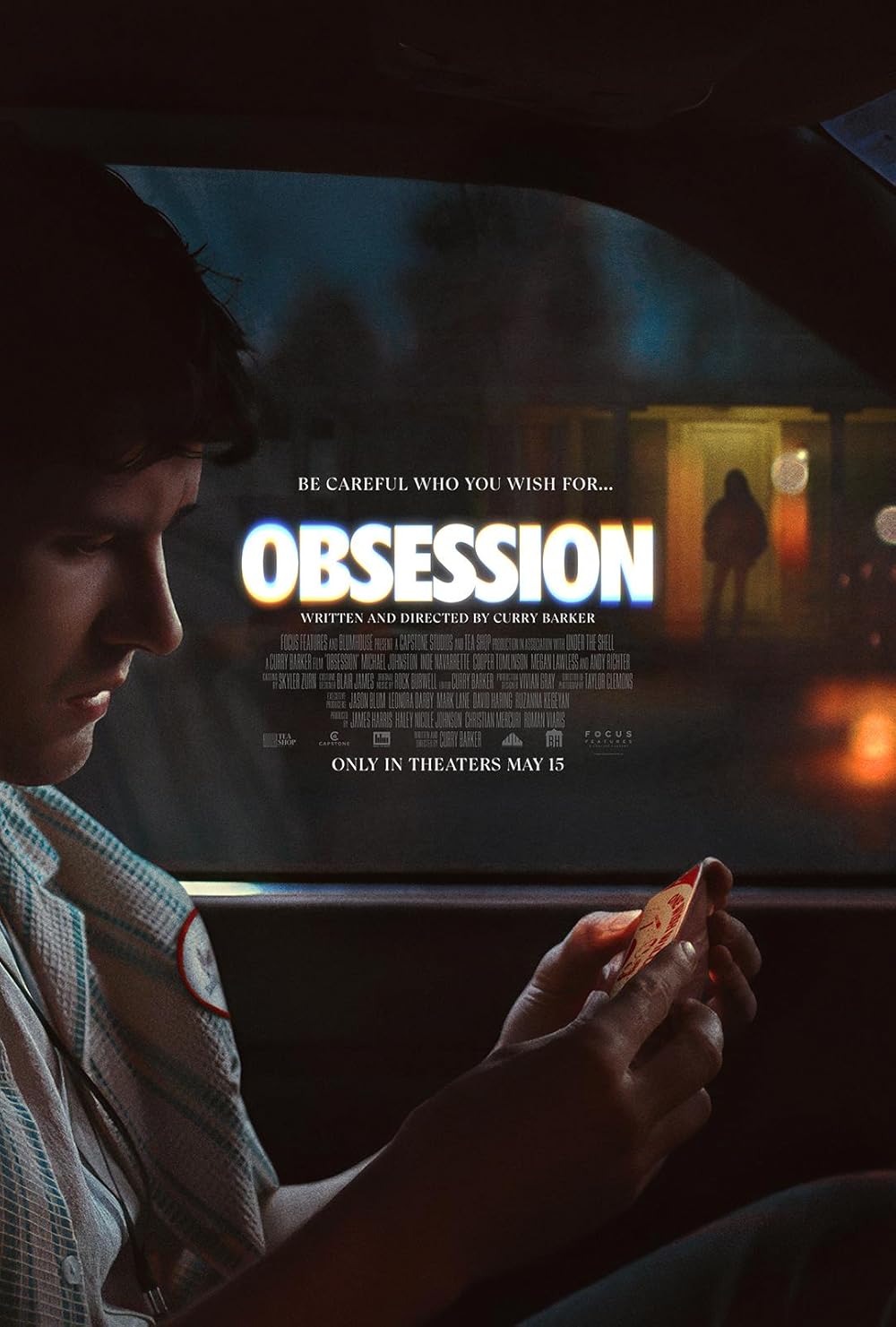
A fun fact about me I don’t think you can reasonably attain from my other interests is that I love scary compilation YouTube videos. I’m obsessed with dubiously acquired stories about paranormal experiences, cursed objects, haunted locations—the list goes on. Sometimes this veers into the overtly fictional (plus-apparent-roleplaying), which I’m honestly not as much of a fan of, but I’ve made a major exception for Curry Barker’s YouTube films. Though I will admit they were filtered through reaction videos that were also half-makeup tutorials, they really captured my attention. I was so excited to see one of Barker’s films in full and in cinemas, and doubly excited at the positive attention it’s getting.
Obsession is a 2025 supernatural horror film in which Bear (Michael Johnston) wishes for his friend and coworker Nikki (Inde Navarrette) to fall in love with him. Via the power of a 1980s collectible “One Wish Willow” toy, she does, which sets off a creepy series of events. It’s taking this well-known monkey’s paw concept and having just an absolute blast with it. Because of how fun this movie was, it is honestly probably one of my favorite theatrical experiences so far this year.
Largely this was due to the nature of the horror. This film makes heavy use of the uncanny, and to a lesser extent social weirdness, making every scary moment equally as funny. If you’ve watched a scary movie in a big crowd, you’ll be familiar with the relieved chuckling following a jump scare, but this was something different. It created this feeling that was so unsettling and spine-tingling yet undeniably funny and impassioned.
Of course, much of this is thanks to Inde Navarrette as Nikki, who knocked it out of the park. She does the uncanny and the funny—and even the small, pitifully frightening moments—with real charm. The ability to balance Nikki’s presumably tragic experience with “Nikki’s” unhinged behavior even seconds apart, just added to that feeling of the uncanny that was explored in a few different ways.
This is a great example of classic horror movie elements—well-known plot, stock characters, and simple setting—to do something truly fun and frightening. If you get a chance to see this one in the theater, I’d totally recommend it, but I also think it would be a perfect scary movie night selection.
Sunday, 24 May 2026
Brand New Cherry Flavor (2021, created by Nick Antosca & Lenore Zion)

Following last month’s enjoyment of another horror limited series with some people in common, Something Very Bad is Going to Happen, I was moved to finally watch this show that’s been on my list forever. Despite the shows being very different in content, the vibes are alike, and that’s what I was craving. A rare instance of thinking I want to watch something, and being correct.
Brand New Cherry Flavor is a horror limited series from 2021 in which witchcraft and associated magic exist in the 1990s Los Angeles film industry. Young director Lisa Nova (Rosa Salazar) moves to LA to develop her short horror film into a feature with the help of immediate creep and betrayer Lou Burke (Eric Lange). Striking a deal with the mysterious witch Boro (Catherine Keener), Lisa curses Lou Burke as revenge.
This show was originally pitched to me due to its stellar aesthetic and feminist messaging, both things that are present in the episodes. It has this vibe that mixes a glam boudoir with colorful lighting and sprawling yet simple foliage. Obviously there’s a bit more to it than that, but its simplicity is key—somehow it captures this dreamy vibe efficiently, which makes this huge, star-filled city feel isolating and almost empty of life. Very much out of a Pinterest board, but like a meaningful Pinterest board; I’m being complimentary in this observation.
Similar to the visual simplicity, it has this narrative scope that is respectably restrained. The conflict that becomes apparent in the first episode never really goes beyond that—in such a way that the events feel more grounded compared to the magical happenings. There’s this narrow social sphere Lisa inhabits that remains distant and eventually dwindles as characters are picked off. The effect of this is distinct to the show, and it gave this lived-in quality to Lisa’s life even as we’re being kept at a distance so much of the time.
The show is horror, but it’s more magical than frightening. There’s no doubt Boro and her magic are hiding something nefarious, and Lisa herself certainly has some skeletons in the closet, but we push away those consequences for as long as possible. Outside of the body horror, there are some scary creature design moments starting early on, but they’re disjointed much in the way Lisa feels distant from her community, in a way that defines her character’s single-minded ambition and (not much) later want for revenge.
I was enamored by this show due to the unique structure and narrative choices. I had a quality I rarely find in shows, where I want to pace it out over time; in this case, that was roughly one episode per night. I would definitely recommend this as a spring-summer watch, although that is perhaps my only criticism of the show, which is that for unclear reasons and in not immediately apparent ways, it takes place around Christmas.
Tuesday, 19 May 2026
Honey Don’t! (2025, dir. Ethan Coen)
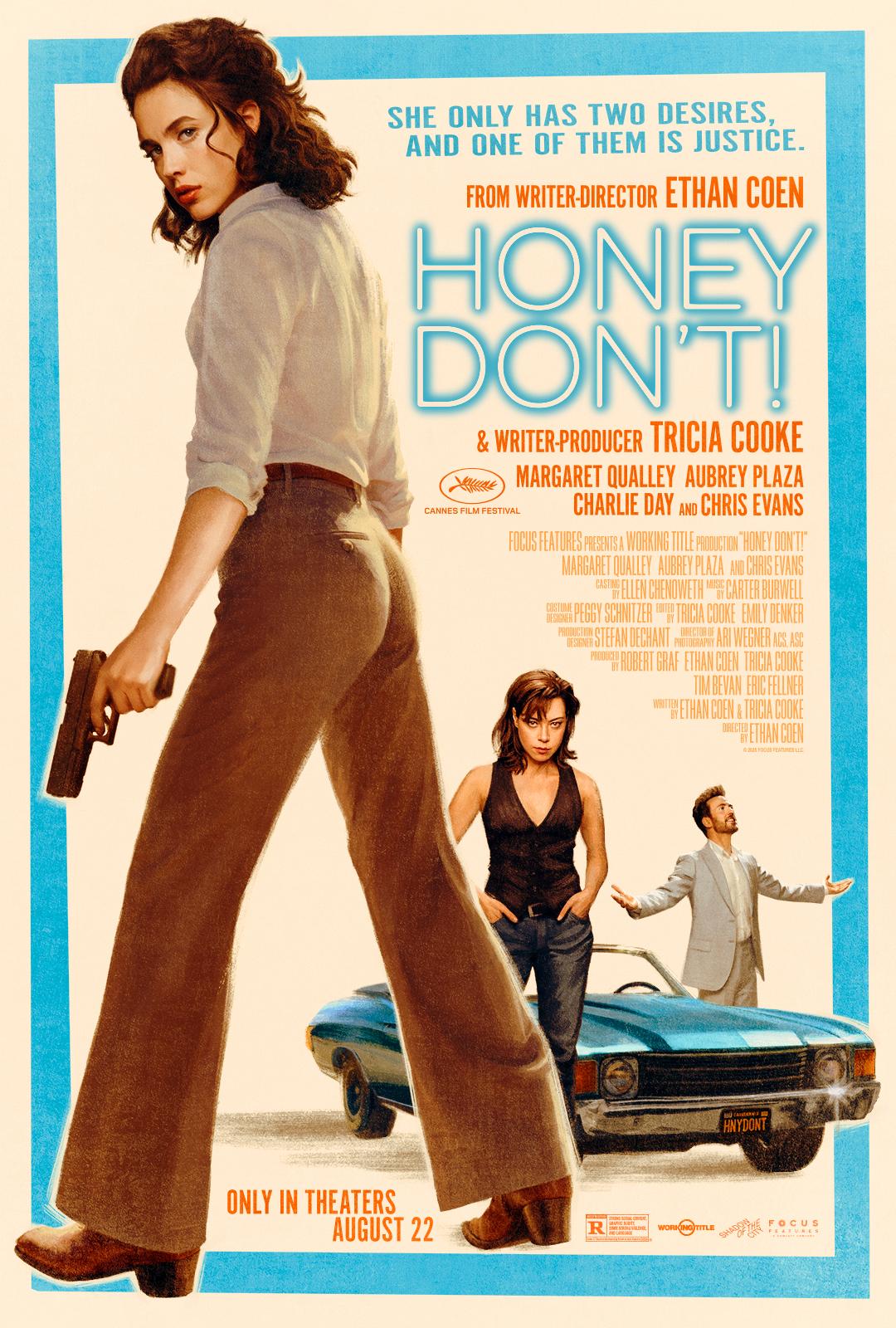
Honey Don’t! is a 2025 neo-noir comedy that has been on my list since before it was released and, at least on paper, totally seems like my thing. It follows PI Honey O’Donahue (Margaret Qualley) investigating a series of disappearances that seem to be connected to the local cult led by Reverend Drew Devlin (Chris Evans). Along the way, she ends up looking for her missing niece and starts seeing a local police officer MG Falcone (Aubrey Plaza). Set in an aesthetically-focused view of Bakersfield, California, the movie definitely takes on that noir dreaminess, where the mystery so often fortuitously unfolds based on the detective’s whereabouts and personal life.
I will just put it out there now: Margaret Qualley carries this movie to an unfathomable degree. She plays this restrained, vintage-clad lesbian PI who I was just immediately charmed by. All of the characters are such characters, but Qualley’s performance is coherent in a way that feels very notable. The film is sort of gag- or goof-focused in a way that occasionally distracts, and I won’t pretend like the casting didn’t play a large part in creating this feeling; while Qualley is funny as Honey, what she brings to the role allows for a more consistent thread than the patchwork gags allow. And she is so, so charming; I’d watch a whole series of Honey easy.
As for the rest of the film, it has excellent aesthetic sensibilities and worldbuilding. The pieces are surely all there, an interconnected mystery with a noir sense in a contrastively mundane setting. The mystery definitely seemed less urgent, Honey’s personal life taking up much more of the screen time, but this is also what worked for me about the film. With that said, the movie admittedly let me down at critical moments. Although I liked the interpersonal drama, the mystery Honey was solving and the way it tied it felt lackluster. The serendipitous and formless blending of the plotlines felt more disjointed than dreamy. Thinking about the movie both before and after, I like it more than I actually felt while watching it. If it has cool bones and pretty paint, the film’s drywall is seriously lacking.
Despite my moderate disappointment, I’m still eager to continue with Ethan Coen and Tricia Cooke’s “lesbian B-movie trilogy.” I have relaxed expectations based on what I’ve seen of the other film that’s been released, but I can’t deny the concepts get me.